

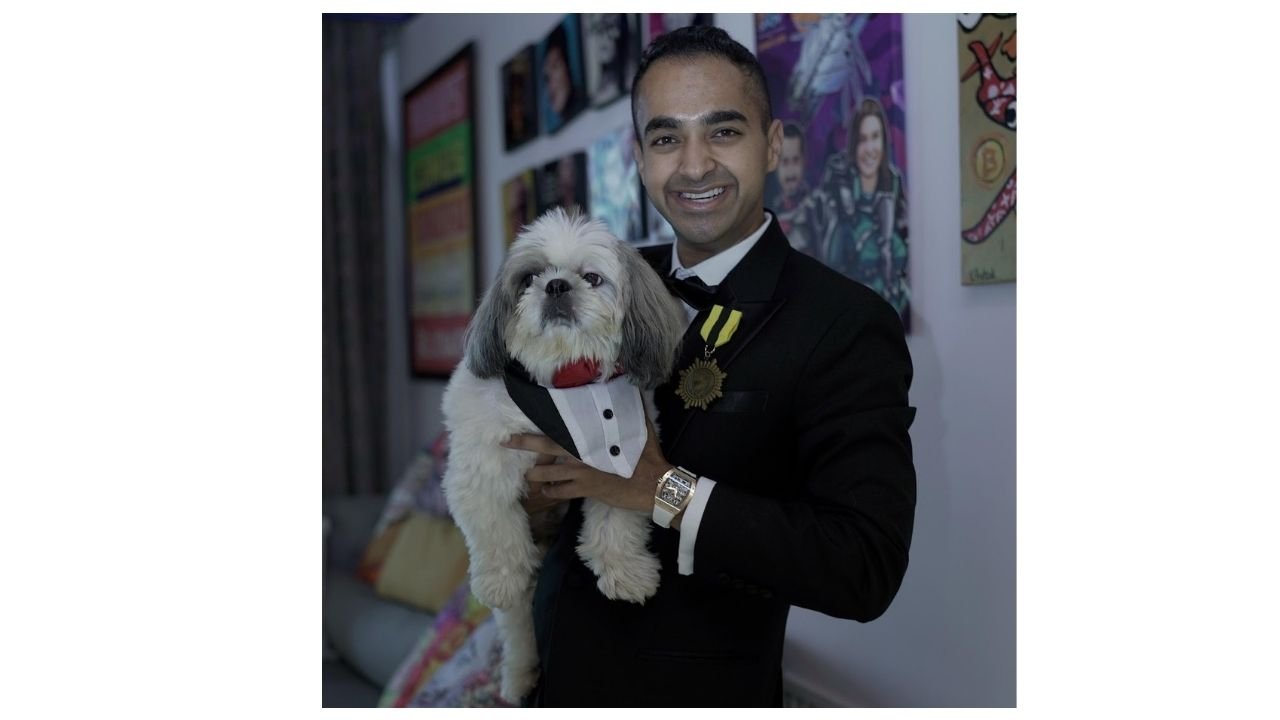
Why adventure capitalist Evan Luthra chooses the long way home
Evan Luthra has spent two decades building things for other people. The question he gets asked most often now has nothing to do with any of them.
The house in Tulum opens straight onto the sea with a private beach, and tonight there are sixty people in it.
There usually are. The music is on the terrace, the kitchen has been commandeered by a founder who insists he can cook, and somebody will end up in the pool. Somebody always does. Luthra moves through it refilling glasses, and stops beside a friend who went quiet an hour ago to ask, away from the others, whether everything is alright at home.
The table on the terrace seats fourteen, and every chair is taken.
Every person in them is a guest.
He built that table. He builds a lot of things. That is the puzzle of this house and, once you notice it, of this man: he has spent a decade building places for people to land, and has not yet built the one he lands in himself.
He wrote the sentence that explains it before anyone thought to ask him the question. I have slept in more countries than most people will visit, it says in his book. I have never once landed in Delhi and felt like a guest.
THE PART INSTAGRAM DOES NOT SHOW
Two million people follow the version of Evan Luthra that exists in squares: the yacht in Monaco, the stage in Silicon Valley, the aerial shot of a farm in Zanzibar that is somehow also his. It is an easy life to resent from a distance and an easy man to misread.
The misreading is the point of this piece.
The man who shows up in person is quieter than his feed, funnier than his reputation, and considerably more Indian than his passport suggests. He calls his mother before he calls anyone else. He is the person at dinner who notices who has gone silent, and who circles back the next morning.
“I think people expect a certain kind of person,” he says. “And then I turn up and I want to know about their family.”

DELHI, AGE TWELVE
He grew up in New Delhi, the only son of Satvinder, a real estate investor, and Rakhi, a fashion entrepreneur. He started his first company at twelve. The exit cleared when he was seventeen, and by his own accounting the money mattered less than what it proved: that the thing in his head could become a thing in the world, and that nobody had to give him permission first.
“My father built with his hands and his name,” he writes in The Millionaire Mindset, his number-one business bestseller. “I built with a laptop in a bedroom he was paying for. We were doing the same thing in different languages.”
Seven hundred investments later the list includes SpaceX, Hashgraph and Ripple, alongside a long tail of founders who took his call when they were two people and a deck. He is General Partner at KOL Capital and founder of a second fund, Ganesha VC. He has given more than ten TEDx talks and carries a Forbes 30 Under 30 nod. He was early to Bitcoin under three hundred dollars, and has been early so many times since that the word has stopped meaning much around him.
WHAT THE MONEY DID NOT FIX
A hundred and ten countries is a magnificent number until you understand what it costs. It costs the ease of being known by people who knew you before, because everyone who knows you now met you after, and after is a difficult place to be met.
“You get to a point where you can’t tell who is in the room for you,” he says. “Everyone is lovely. Everyone is available. That is exactly the problem.”
He built a life with almost no fixed points, and is candid that he is now revisiting the design. He saw it coming, in print: “Freedom is not the reward you get after the work. Freedom is the product. If the life you built still tells you where to be on Monday morning, you have not finished building it.”
So he finished. And then found himself standing in it, hosting.
“The next level of success,” he says, “is giving the people you love the same freedom you have.” It is why the yachts he charters fill up with friends, and why he is now shopping to buy one. “Anyone can pay for a room,” he writes. “The luxury is paying for someone else’s peace of mind.”
THE EVIDENCE OF A DOMESTIC MAN
For a man with no fixed address, Luthra is startlingly attached.
The other pole of his year is Melbourne, where he keeps a penthouse and spends a month or more at a stretch, largely because his niece and nephew are there, the third generation of the family growing up Australian. He is the uncle who turns up, and is on the floor with them within the hour. It is the least strategic thing he does and, watching him talk about it, plainly the most restorative.
Every five or six weeks, wherever he is, he flies to India to see his parents. Not for an occasion. Just to be in the house. “It’s not a sacrifice, it’s a responsibility,” he says, then corrects himself. “No. It’s a privilege. Most people my age don’t get to. So I do.”
In Zanzibar he runs an organic farm with his father: papaya, red banana and passion fruit across fifteen hectares, solar-powered, training local farmers as it grows. It is by some distance the least glamorous thing he owns and the one he talks about longest. A son and his father, growing fruit, in the same language at last.
And it is in Zanzibar that the pattern of his life reaches its logical conclusion. On the water nearby, he is building his own resort: one hundred and twenty villas with a private marina, an airstrip, restaurants and shopping, a place designed from the first drawing not as a hotel but as a community. The plan is unapologetically personal. Fill it with the people he cares about. Give his friends, his family and the founders he has backed a paradise with their name already on the list.
“I’ve stayed in everyone else’s idea of paradise,” he says. “I’m building mine.”
Somebody eventually says the obvious thing, that even now, he keeps building homes for everyone else first.
He does not deflect. “Yes,” he says. “I’ve noticed.”
WHAT HE IS LOOKING FOR
He answers it more briefly than expected. Kind, intelligent, adventurous. Modern in her outlook, respectful of where she comes from. Someone who treats the driver and the chairman with the same warmth, because that is the test he quietly runs on everyone.
And someone who wants the life to mean something. Luthra runs a school in Zanzibar and supports a school and an NGO in Delhi, and he talks about a future wife less as a passenger than as a partner in that work. “The dream is someone who wants to see the world and give something back to it,” he says. “Someone who could run the foundation with me, or run it better than me.”
He is aware his life looks frictionless from the outside and does not pretend otherwise. “I’m grateful. I get to live an unusual life, and I get to share it.” What he asks in return is adaptability, the ability to enjoy the best of it without needing it. The right woman, he suspects, is the one who is unbothered when there is no jet waiting, because the point was never the jet.
“Whoever I marry, I’ll be with her,” he says. “That’s the actual luxury. I don’t leave for an office at eight. I can build my whole life around a person instead of a calendar. Most men can’t offer that. I can.”
THE LONG WAY HOME
By three the music is off and the house has gone soft. In Delhi it is already afternoon, and his mother has called twice.
Ask him what success looks like in ten years and he does not give a number, which is either media training or the truth. He says: the resort finished, the marina full, the school bigger. His parents on the terrace, his niece and nephew running through it. Somebody in the chair across from him who has heard all the stories and is not leaving on Sunday.
He wrote the ending himself, in the afterword of his own book, years before anyone thought to ask.
I set a table for more people than I had. That was not a mistake. That was the plan.
Final editorial manuscript, incorporating the approved Tulum, Zanzibar and relationship revisions.
