

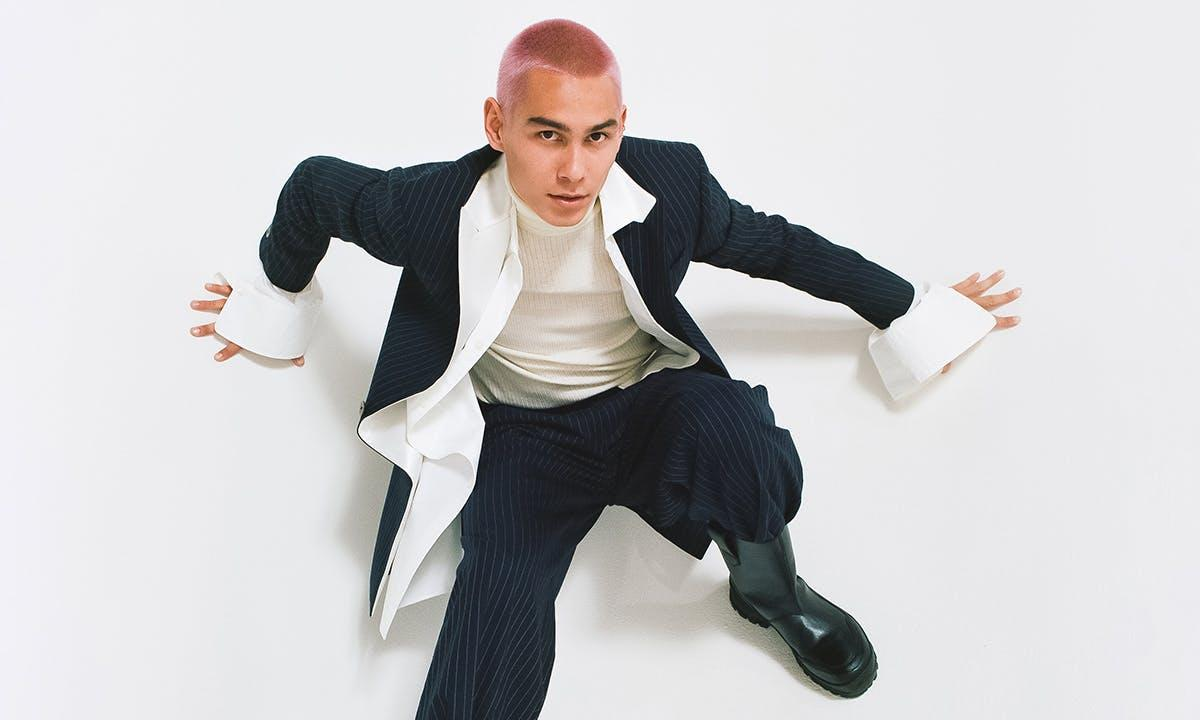
In the fast-paced ecosystem of global fashion, virality has become a currency of its own. At Milan Fashion Week, where legacy houses and emerging designers compete for attention, one name cut through the noise with undeniable impact: Evan Mock. Known for his fearless aesthetic and boundary-pushing style, Mock delivered what many have called the “most viral look” of the season—a moment that encapsulated the intersection of fashion, identity, and digital culture.
Evan Mock’s rise within the fashion world has been anything but conventional. Originally gaining recognition as a skateboarder and photographer, he transitioned into modeling and acting, bringing with him a distinct visual identity shaped by youth culture, streetwear, and artistic experimentation. This background is crucial to understanding why his Milan Fashion Week appearance resonated so strongly: it wasn’t just an outfit—it was an extension of a lifestyle.
The look itself was a masterclass in controlled boldness. At first glance, the outfit appeared deceptively simple: a sharply tailored black suit. However, closer inspection revealed the nuances that elevated it beyond traditional menswear. The silhouette was clean but slightly exaggerated, with structured shoulders and a relaxed drape that hinted at contemporary reinterpretations of classic tailoring. This balance between structure and fluidity is a hallmark of modern fashion, where rigidity is softened to create movement and individuality.
What truly set the look apart, however, was Mock’s styling. His signature bleached or brightly colored hair—often a focal point of his aesthetic—added a striking contrast to the monochrome outfit. Paired with oversized, futuristic sunglasses, the ensemble took on a cyberpunk edge, blending classic tailoring with avant-garde influences. This juxtaposition is precisely what drives virality: the unexpected fusion of opposing elements.
Accessories were minimal but impactful. A subtle chain or understated jewelry may have been present, but nothing distracted from the core composition. The emphasis remained on silhouette, texture, and attitude. In an era where over-accessorizing is common, this restraint demonstrated a sophisticated understanding of visual hierarchy.
The viral success of the look cannot be separated from the role of social media. Platforms like Instagram and TikTok amplify fashion moments in real time, transforming runway appearances into global conversations within minutes. Mock’s outfit was inherently “shareable”—visually striking, easily recognizable, and aligned with current aesthetic trends. The clean lines of the suit made it accessible, while the edgy styling ensured it stood out in crowded feeds.
Beyond its immediate impact, the look also reflects broader shifts within menswear. There is an increasing willingness to blur the lines between formal and experimental fashion. Traditional suits are no longer confined to conservative contexts; they are being reimagined as canvases for self-expression. Mock’s ensemble exemplifies this evolution, proving that tailoring can be both classic and disruptive.
Another key factor in the look’s success is authenticity. Evan Mock does not appear to be “trying” to fit into fashion—he brings his own perspective into it. This authenticity resonates with younger audiences who value individuality over conformity. In a landscape saturated with curated images, genuine personal style becomes a powerful differentiator.
The cultural implications of this moment are significant. Fashion has always been a reflection of societal shifts, and Mock’s look speaks to a generation that is comfortable with hybridity—mixing influences, redefining norms, and rejecting rigid categories. The combination of a formal suit with unconventional styling elements mirrors a broader cultural movement toward fluidity in identity and expression.
From a technical standpoint, achieving such a look requires precision. The tailoring must be impeccable, as any flaw would be magnified by the outfit’s simplicity. The styling must be intentional, with each element contributing to the overall narrative. Even posture and demeanor play a role; Mock’s confident, almost nonchalant presence reinforced the outfit’s impact.
For those looking to draw inspiration from this look, the key lies in balance. Start with a strong foundation—well-tailored basics in neutral tones. Then introduce one or two distinctive elements, whether through accessories, grooming, or styling. The goal is not to replicate the look exactly but to capture its essence: confidence, clarity, and controlled experimentation.
In conclusion, Evan Mock’s appearance at Milan Fashion Week was more than just a viral moment—it was a statement about the future of fashion. By combining classic tailoring with contemporary edge, he demonstrated how tradition can be reinterpreted to reflect modern sensibilities. The look’s success underscores the importance of authenticity, precision, and the ability to navigate the space between simplicity and boldness.
As fashion continues to evolve in the digital age, moments like this will define its trajectory. And in a setting as influential as Milan Fashion Week, standing out requires more than just good taste—it demands vision. Evan Mock delivered exactly that, solidifying his position as one of the most compelling style figures of his generation.
